Do You Need an Airbrush for Miniatures?
Find out if an airbrush is worth it for beginner miniature painters, and what you can achieve with regular brushes instead.
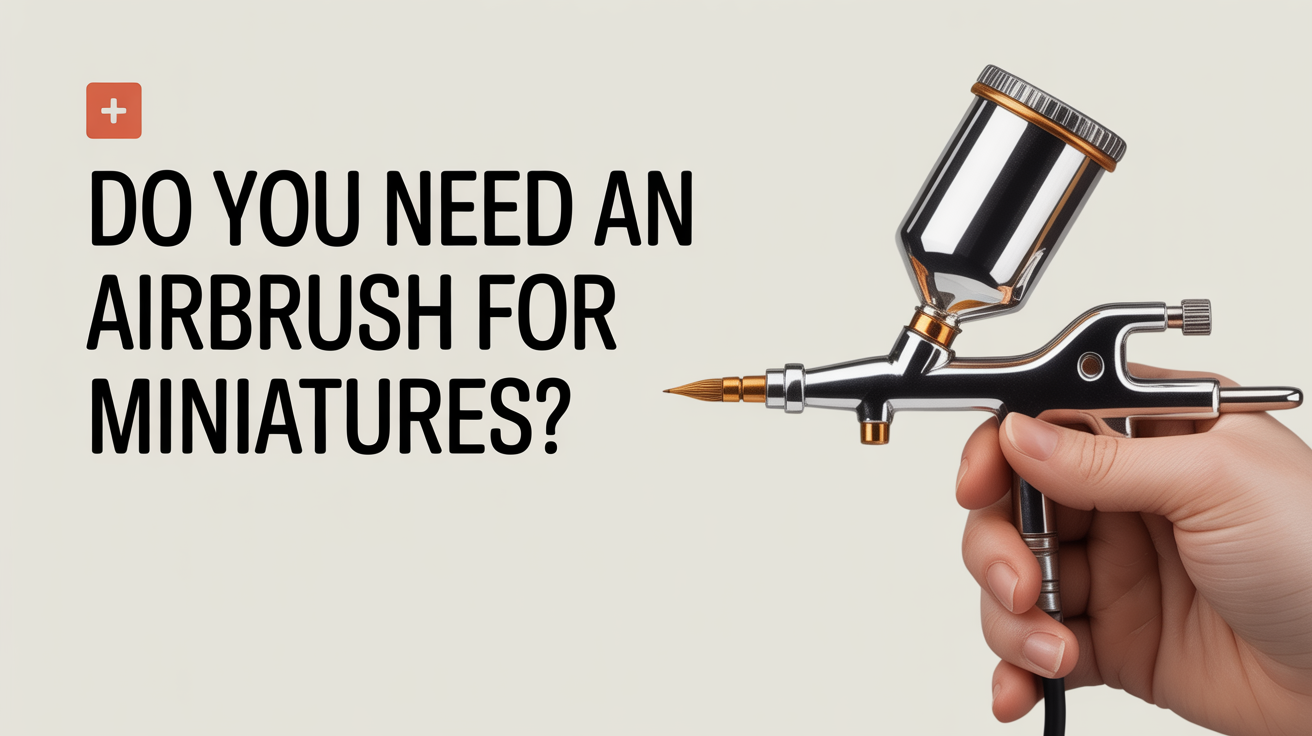
No, you do not need an airbrush to paint miniatures. Brushes alone can take you from bare plastic to a finished, table-ready model using the same core techniques that most painters use throughout their hobby life. An airbrush is a useful tool, but it solves specific problems rather than being a requirement for the craft.
This guide walks through what an airbrush actually does well, where a regular brush is just as good or better, and how to decide if buying one makes sense at your current stage.
What an Airbrush Actually Does
An airbrush atomizes paint into a fine mist and sprays it onto a surface. For miniatures, this translates into a few practical advantages.
Smooth base coats and primer layers. Spraying paint on gives you a thin, even coat with no visible brushstrokes. This is especially useful on large flat areas like vehicle panels or big monster models.
Smooth blending. Because you can layer very thin coats of color while they are still wet, airbrushes make blending gradients from one color to another much easier to control on large surfaces.
Speed across armies. If you are painting thirty infantry models at once, laying down base colors with a brush on every single one takes a long time. Spraying them all in batches is considerably faster.
Zenithal priming. This is a technique where you prime black, then spray white or grey from directly above to create a built-in shading effect before you apply any paint. It is possible with spray cans but more controllable with an airbrush.
What Brushes Handle Just Fine
For most beginner projects, a set of good brushes covers almost everything.
Washes, layering, drybrushing, edge highlighting, and detail work are all brush techniques. These are the foundation of the core painting sequence and they produce results that look great on the table.
Base coating with a brush takes longer than spraying, but it is completely achievable. A medium flat brush or a basecoat brush picks up enough paint to cover a model in a few passes. Thinning your paints correctly is what makes brush base coats smooth, not the tool you use to apply them.
Blending on small models is also more practical with a brush than most beginners expect. Wet blending, feathering, and layering are all brush techniques that give you fine control at the scale of a 28mm figure. An airbrush can feel oversized for very small detail work.
Airbrush vs Brush: A Practical Comparison
| Task | Brush | Airbrush |
|---|---|---|
| Priming | Spray can works better; brush primer possible | Very good, controllable |
| Base coating (small model) | Practical | Can feel like overkill |
| Base coating (large model or vehicle) | Time-consuming but doable | Faster, smoother result |
| Washes and shading | Excellent | Not the right tool |
| Drybrushing | Excellent | Not the right tool |
| Zenithal highlight | Spray can works | Very controllable |
| Smooth blending on large areas | Takes skill and practice | Easier to achieve |
| Fine detail and face painting | Excellent | Too imprecise |
| Cleanup time after session | None | 10 to 20 minutes |
The Real Costs of an Airbrush Setup
The purchase price of an airbrush is only part of the cost. A beginner-friendly dual-action airbrush runs from around $50 to $150. A compressor capable of driving it consistently costs another $70 to $150 or more. You also need a spray booth or dedicated space with good airflow, cleaning supplies, and airbrush-specific paint thinner.
Beyond money, there is time. Cleaning an airbrush after every session takes ten to twenty minutes when done properly. Flushing color between passes, preventing tip dry, and disassembling for deeper cleans are all habits you have to build. Brush painters just rinse a brush and call it done.
Safety is non-negotiable with an airbrush. Atomized paint particles stay suspended in the air and should not be inhaled. You need proper ventilation in your painting space and, for anything other than water-based acrylics, a respirator rated for fine particles. Read the manufacturer's safety instructions for every product you spray.
When It Starts to Make Sense
An airbrush becomes more useful as your hobby grows in specific directions.
If you are painting large models, vehicles, or scenery pieces, the smooth coverage and speed start paying off. If you want to paint big armies quickly and spend more time on highlights and detail with a brush, priming and base-coating batches by air is a real time saver. If smooth color gradients on larger surfaces are something you want to achieve, an airbrush makes that significantly more approachable.
For a painter working through their first few models, a small collection of brushes and a spray can of primer will take you far. Choosing the right brushes and learning how to use them well is a better investment at the start than adding equipment with its own learning curve and maintenance routine.
That said, if you already know you want to paint vehicles or large fantasy monsters, or if you find brush base coating genuinely frustrating, buying a basic airbrush setup earlier is a reasonable choice. It is not a wrong decision, just one that comes with extra work to learn the tool.
Frequently Asked Questions
Can beginners learn to use an airbrush?
Yes, but there is a learning curve. Pressure settings, paint consistency, distance from the model, and trigger control all affect the result. Most beginners find that brush skills are faster to develop and produce satisfying results sooner. Starting with brushes first, then adding an airbrush later, tends to work well.
Do I need an airbrush for smooth blending on small models?
No. On a 28mm figure, smooth blending is more practical with a brush. Layering thin coats of paint and feathering edges with a damp brush gives you control that an airbrush, which applies paint in a wider pattern, cannot match at that scale.
What is the minimum airbrush setup to get started?
A dual-action gravity-feed airbrush and a small piston compressor with a moisture trap is the standard beginner setup. Dual-action means you control both airflow and paint flow with one trigger, which gives you more flexibility. Budget around $150 to $250 for a functional entry-level combination.
Is a spray can of primer a good alternative to an airbrush?
For priming, yes. Rattle-can primers designed for miniatures give very good results and cost far less than an airbrush setup. The tradeoff is that you have less control over the coat and you depend on a specific product staying available. An airbrush lets you use any compatible primer thinned to your preference.
Will an airbrush make my miniatures look better?
Not automatically. An airbrush handles specific tasks well, but the techniques that make a miniature stand out on the table, washing into recesses, highlighting raised edges, picking out details, are all done with a brush. Buying an airbrush without developing those underlying skills will not produce better results on its own.