Tabletop Standard vs Display: How Good Do Your Minis Need to Be?
Learn the difference between tabletop standard and display painting so you can set realistic goals and enjoy miniature painting from your very first model.
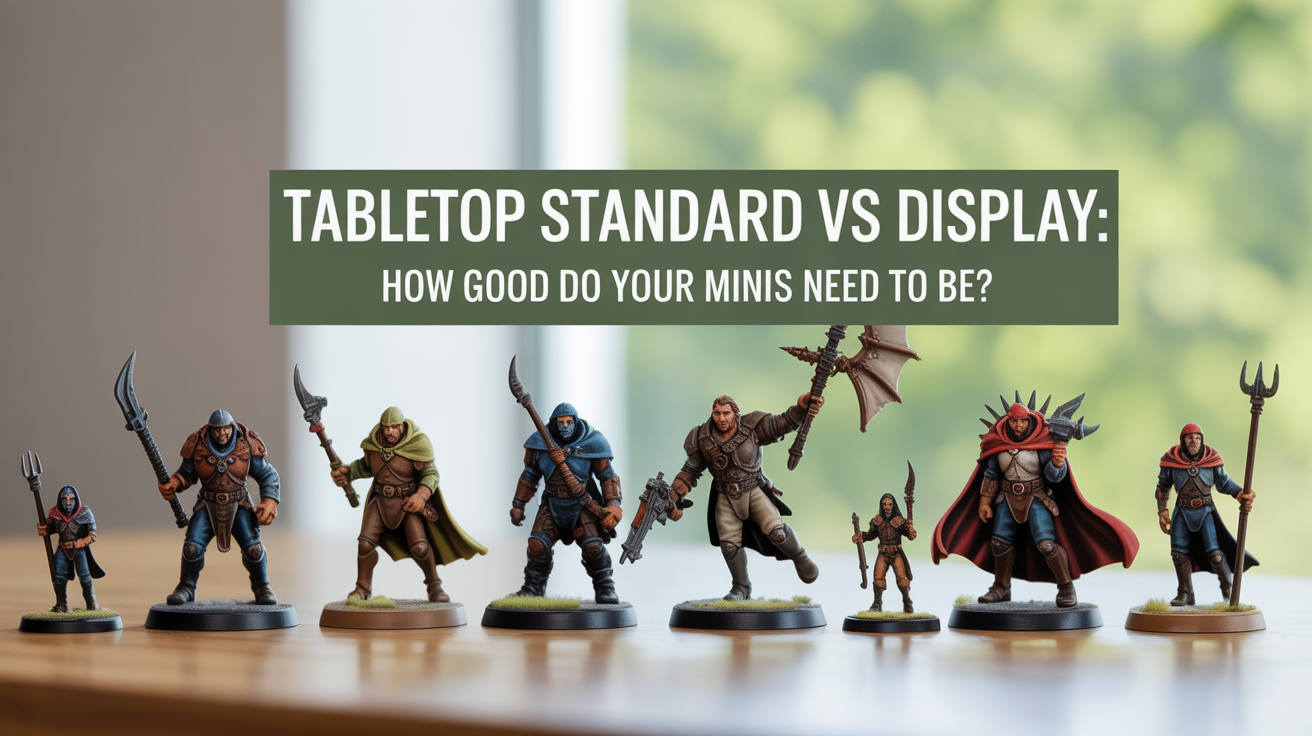
Your minis need to look good enough for you. That is the honest answer. But if you want something more concrete, there is a real and useful distinction between tabletop standard and display painting, and knowing which one you are aiming for makes the whole learning process feel much less overwhelming.
Most beginners land somewhere in the tabletop standard range, and that is a perfectly complete destination in its own right.
What Tabletop Standard Actually Means
Tabletop standard means a miniature that reads clearly at arm's length across a gaming table. Every area has a base color, the recesses have been shaded so the detail pops, and there is at least some highlighting to give the model a sense of dimension.
That's a lower bar than it sounds. A three-step process, base coat plus wash plus drybrush, can get almost any miniature to tabletop standard without any advanced technique at all. The model will not look photographic, but it will look finished, intentional, and good on the table.
Some people also use the term "battle ready" for a similar idea: a minimum standard where every surface is painted, washes are applied, and the base is done. That level is completely acceptable at most game tables and is exactly what you should aim for when getting started with miniature painting.
What Display Standard Means
Display painting is miniatures intended for close viewing, photos, competitions, or a shelf. The painter works at magnification, blends colors smoothly, adds freehand patterns, and can spend hours on a single face. This is the level you see in painting competition entries or on studio box art.
Display painting is genuinely difficult. It requires good control over thin paint, patience with multiple blending passes, and a lot of practice with techniques like wet blending and non-metallic metal. None of that is closed off to beginners forever, but expecting it on your first dozen models sets you up for frustration.
There are also levels in between. A "showcase" standard or "advanced" tabletop standard sits above battle ready but below full display work. Many painters land here after a year or two of regular practice. Smooth color transitions, careful eyes, and crisp edge highlights start appearing naturally as muscle memory builds.
A Quick Comparison
| Level | Who it's for | Time per model | Viewed from |
|---|---|---|---|
| Base coat only | Fastest playable result | 15 to 30 minutes | Across the table |
| Battle ready | Most game tables | 1 to 2 hours | Arm's length |
| Tabletop standard | Good-looking army | 2 to 4 hours | Table to close-up |
| Advanced tabletop | Proud display on shelves | 4 to 8 hours | Close-up |
| Display / competition | Photography, contests | Many hours | Macro lens or 1-foot viewing |
These are rough ranges. Every painter works at a different pace, and the same model can take half the time once you have painted similar models before.
How Good Your Minis Need to Look Depends on How You Use Them
For a game army, the practical goal is consistency. A whole force painted to solid tabletop standard looks better on the table than one showpiece model surrounded by grey plastic. If you have 30 infantry to paint, spending eight hours each on them is not realistic. Getting every one to battle ready is a real achievement.
For a single character model or a centerpiece like a large monster, putting in extra time is satisfying and makes sense. Most painters treat characters and heroes as chances to practice more advanced techniques, while rank-and-file troops get a faster, efficient workflow.
If you only paint for the hobby of it and never play a game, none of this applies. Paint to whatever level you find rewarding. Some people stop at washes because they love the speed. Others are hooked on smooth blending and do not care about playing at all.
The Gear You Need Does Not Change Much by Level
Tabletop standard and display standard require almost the same basic supplies for miniature painting. A few brushes, acrylic paints, primer, and a wash are enough to hit tabletop standard comfortably. Display painting eventually calls for very thin detail brushes, wet palettes, and specific paint brands, but none of that is necessary while you are learning.
When using spray primers or an airbrush for priming and base coating, always follow the manufacturer's safety instructions and use proper ventilation. That applies whether you are painting for the table or for a competition shelf.
Building Up to Higher Standards Takes Time, Not Talent
There is a common assumption that display-level painters have some natural gift for art. Most of them will tell you the opposite. They started exactly where you are, with shaky brushwork and uneven base coats, and the skill came through repetition.
A useful mindset is to pick one technique to practice per model. On one mini you focus on getting cleaner edges on your base coat. On the next you work on thinning your wash so it does not pool badly. On the next you try a controlled drybrush pass. Choosing the right miniature to start with helps here too, since a simpler sculpt lets you practice technique without fighting complex geometry at the same time.
Progress is not always visible mini to mini, but it becomes obvious when you compare something you painted six months ago to something you painted today.
Frequently Asked Questions
Is tabletop standard good enough for playing games? Yes, completely. Most players and game groups are happy with any model that is painted and based. Some organized events require a minimum standard, usually "three colors and a base," which is below even battle ready. Unpainted models are less common at organized play, but a basic tabletop paint job is always accepted.
How do I know if my mini has reached tabletop standard? Set it on a table and step back about two feet. If you can clearly see the main colors and the model reads as a recognizable subject, you are there. If it looks like a grey blob or has large unpainted patches, it needs a bit more work.
Do I need to highlight to reach tabletop standard? A wash alone can get you surprisingly close. Adding a light drybrush over raised areas after the wash brings most models firmly into tabletop standard territory without needing edge highlighting at all. Edge highlighting is a next step, not a requirement.
Can I mix painting levels within an army? Yes, and many painters do. A fast efficient paint job on rank-and-file soldiers, with more time invested on named characters and monsters, is a common approach. The variation is not jarring and lets you spend extra effort where it has the most visual impact.
Will I get bored of tabletop standard once I improve? Some painters do move toward higher standards as they grow. Others find that painting quickly and seeing models hit the table is what they enjoy most, and they stay at that level by choice. There is no progression you are obligated to follow. Paint at the level that keeps you picking up the brush.