Setting Up a Miniature Painting Workspace
Learn how to build a miniature painting workspace setup with the right desk, daylight lighting, ventilation, and storage to paint comfortably from day one.
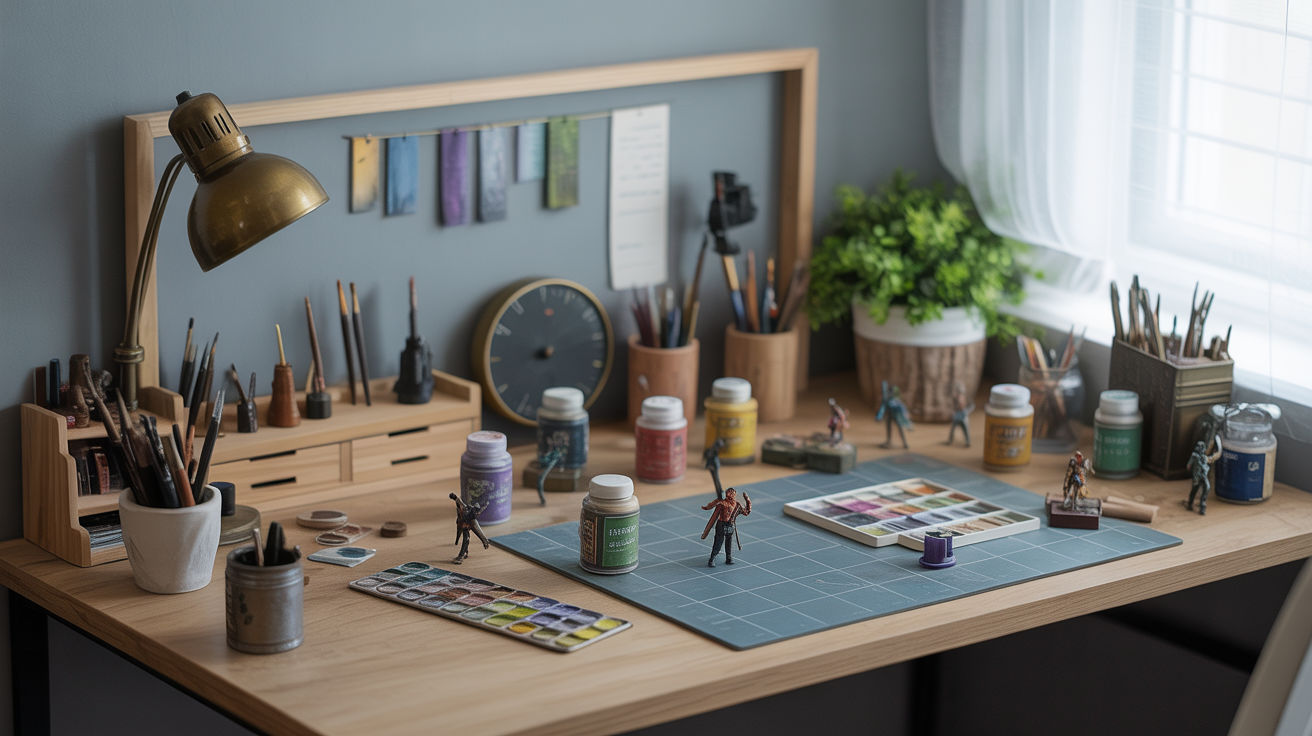
A good miniature painting workspace setup does not need to be expensive or elaborate. You need enough light to see what you are doing, a stable surface to work on, and somewhere to keep your paints from rolling onto the floor. Get those three things right and almost everything else is optional.
Choosing a Desk and Surface
Size matters less than stability. A wobbly folding table is genuinely frustrating when you are trying to paint a two-millimeter eye, so if you can anchor your workspace to something solid, do that first.
A standard writing desk (around 120 cm wide) gives you room for a lamp, a water pot, your current paints, and the model itself without feeling cramped. Smaller spaces work fine; a 60 cm section of kitchen counter has launched plenty of excellent paint jobs. The main thing to avoid is a surface that vibrates when someone walks past.
A few surface additions that help:
- Cutting mat or cork tile under your work area protects the desk and gives you a grippy surface.
- Lazy Susan (turntable) lets you rotate the miniature without picking it up constantly. Cheap plastic ones from kitchen stores work perfectly.
- Small clamp or blu-tack block holds the mini while you paint so your hand oil does not contaminate the primer.
Chairs are underrated. A chair that lets you sit with your elbows on the desk at roughly a 90-degree angle keeps your arms steady for long sessions. Hunching over a coffee table for two hours will ache.
Before you buy anything, it is worth reading what you need to start painting miniatures for a full breakdown of starter supplies, including the desk tools that actually move the needle.
Lighting for Miniature Painting
Lighting is the single most important feature of a mini painting desk setup. This is not an exaggeration. Bad light makes colors look wrong, hides mold lines you should have removed, and strains your eyes until you stop painting for the evening.
Daylight-Balanced Bulbs
Natural daylight sits around 5000K to 6500K on the color temperature scale. Bulbs in that range render colors accurately, so the blue you mix under the lamp looks like a blue on the shelf, not a grey. Warm household bulbs (2700K to 3000K) shift everything toward orange and make color-matching guesswork.
Look for LED desk lamps marketed as "daylight" or "cool white" with a CRI (Color Rendering Index) of 90 or above. CRI measures how faithfully a light source shows color compared to natural sunlight. A CRI of 95 plus is excellent; below 80 starts to cause problems. Many dedicated hobby lamps advertise high CRI specifically because the miniature painting audience cares about it.
Positioning Your Lamp
Position the lamp to one side (most right-handed painters prefer the lamp to the upper left) so it casts a slight shadow across the model. That shadow helps you read the surface contours and judge where your highlights and shading need to go. Directly overhead lighting flattens everything.
Natural Light
A window is a bonus, not a requirement. Direct sunlight shifts through the day and can glare off wet paint, making it hard to judge coverage. Bright indirect light from a north-facing window (or south-facing in the Southern Hemisphere) is ideal if you have it. If the sun moves across your workspace, a lamp on a dimmer gives you a consistent baseline regardless of the time of day.
Workspace Essentials: A Quick Reference
Here is a summary of what a functional hobby painting station needs, roughly in order of priority:
| Item | What to Look For | Notes |
|---|---|---|
| Lamp | Daylight LED, CRI 90+, adjustable arm | The biggest quality-of-life upgrade |
| Water pot | Two containers (rinse + clean) | Yogurt pots or jam jars work fine |
| Palette | Wet palette or ceramic tile | Keeps paint workable longer |
| Cutting mat | A3 size or larger | Protects the desk surface |
| Turntable | Any smooth-spinning platform | Even a lazy Susan from a kitchen store |
| Spray area | Outdoors or near ventilation | See ventilation section below |
| Storage | Small drawers or a tackle box | Sorted by color family or brand |
None of these items need to be purpose-built hobby products. The miniature painting community has a long tradition of raiding kitchen stores, hardware shops, and dollar stores for perfectly functional substitutes.
Ventilation and Spray Priming
Aerosol spray primers and varnishes release fine particles and solvents that you should not be breathing indoors, full stop. A crack in a window is not enough. This is one area of miniature painting workspace setup that genuinely affects your health, not just your paint results.
Best option: Spray outdoors. Take the model, the can, and a cardboard box to the garden or a balcony. Shoot inside the box so overspray does not drift. Most primers dry to the touch in five to ten minutes, so you are not outside for long.
If outdoors is not practical: A spray booth with an active fan and a carbon filter helps significantly indoors. Purpose-built hobby spray booths exist in the $50 to $150 range. Position one near an open window and point the exhaust outside. A box fan taped to a window with a furnace filter over the intake works as a makeshift alternative.
Airbrushing raises the same concerns in a more sustained way. If you move to an airbrush setup, a proper spray booth with extraction becomes more important, not less. But for brush-only painters using occasional aerosol primers, outdoor spraying solves the problem cleanly.
Ventilation does not apply to regular acrylic brush painting. Water-based acrylics in the open air are benign.
Organizing Your Paints and Storage
Disorganized paints slow you down. Hunting for a specific brown through a pile of fifty pots mid-session breaks concentration. A few approaches that work well:
Small drawer units (hardware store organizers or cosmetics storage towers) let you sort paints upright by color family. You can see the labels without picking up every pot.
Tackle boxes or bead organizers are excellent for pigments, washes, and technical paints separated from base coats. The compartments keep pots from knocking each other over.
Paint racks designed for hobby paints hold bottles at a slight angle so you can read labels at a glance. Printable designs exist for 3D printers if that is relevant to you.
The system matters less than sticking to one. If you always put washes in the same spot, you will reach for them without thinking.
Beyond the paints, keep a small brush cleaner (soap or dedicated brush cleaner) beside the water pots. Rinsing brushes immediately after each color and cleaning them properly at the end of a session makes brushes last years rather than months.
Starting Small and Expanding
A miniature painting workspace setup does not have to be permanent or complete before you start painting. Many painters begin with a cleared corner of a dining table and a clip-on daylight lamp. That is enough to learn the craft.
Add things as you understand what you actually need. You might find a wet palette changes how you work. You might find the turntable is essential or that you never use it. Buying everything at once before you know your habits usually means buying things you do not want.
If you are still working out what to paint first, choosing your first miniature to paint walks through what makes a model good for beginners. And if you want a broader look at the whole craft before setting up, how to start painting miniatures: a beginner's guide covers the full picture.
Frequently Asked Questions
How much space do I need for a miniature painting workspace?
A surface of around 60 by 90 cm is workable for most setups. You need room for a lamp, two water pots, your palette, and the model itself. Any space smaller than that starts to feel cramped during longer sessions, though it is not impossible.
What color temperature bulb is best for painting miniatures?
Aim for 5000K to 6500K with a CRI of 90 or higher. Bulbs in that range render paint colors accurately so what you see under the lamp matches what you see in daylight. Warm yellow bulbs in the 2700K range shift colors toward orange and make mixing and color judgment harder.
Can I prime miniatures indoors?
Aerosol spray primers should not be used indoors without proper extraction. The particles and solvents are worth taking seriously. Spraying outdoors into a cardboard box is the simplest fix. If outdoor access is limited, a hobby spray booth with active ventilation near an open window is the practical alternative.
Do I need a dedicated hobby lamp or will any desk lamp work?
Any daylight LED lamp with a CRI above 90 will do the job. Dedicated hobby lamps often combine high CRI with a flexible arm and consistent brightness, which is convenient, but an adjustable daylight LED from a general lighting retailer costs less and works just as well. Check the CRI rating on the packaging before you buy.
Is a wet palette necessary?
Not necessary, but very useful. A wet palette keeps acrylic paint workable for much longer than a dry palette or a ceramic tile, which reduces waste and gives you more time to blend. A simple DIY version (a shallow container, damp paper, and baking parchment) costs almost nothing and performs the same as most commercial ones.